

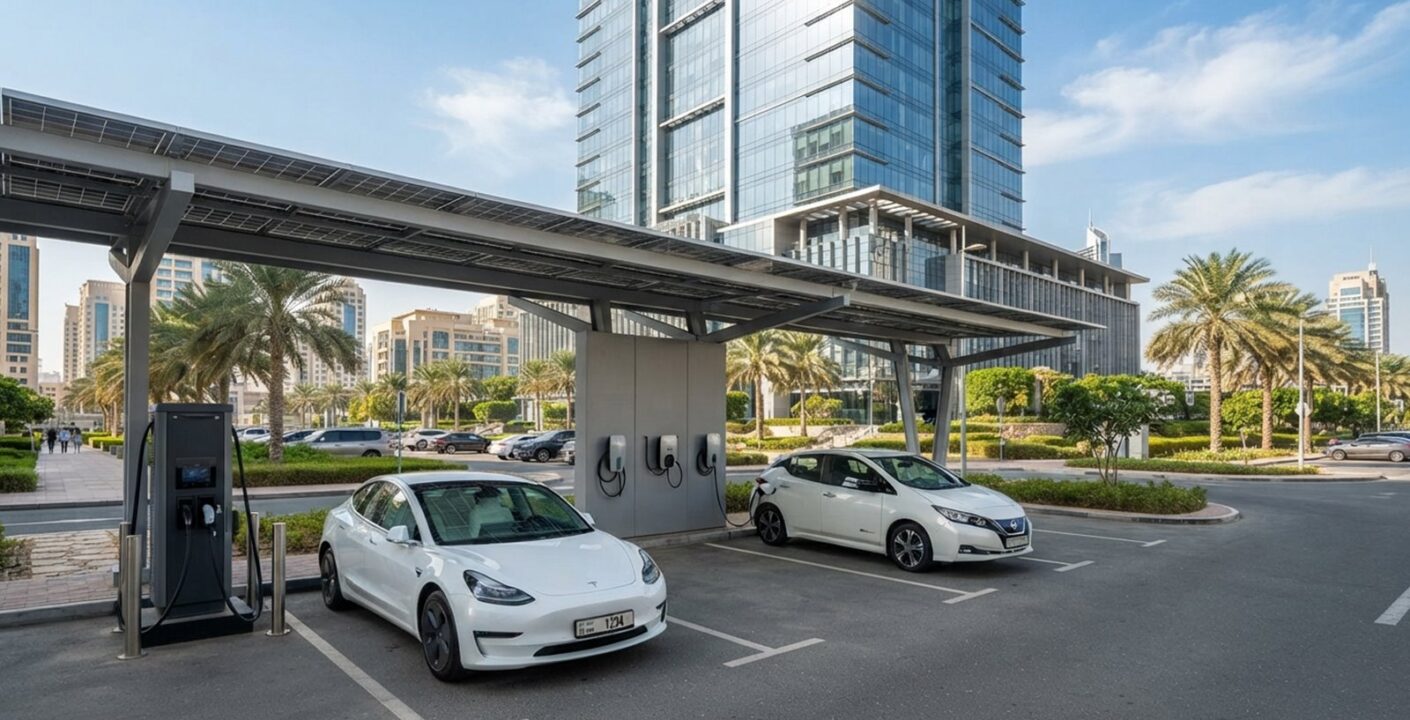
The best EV charger for commercial buildings depends on how long vehicles stay parked, how frequently charging is needed, and how much electrical capacity the property can provide. For many offices, hotels, and mixed-use developments, 22 kW AC chargers are a practical starting point because vehicles often remain parked for several hours. Shopping centres, fleet depots, and locations requiring faster vehicle turnaround may benefit from DC fast chargers or a combination of AC and DC equipment.
There is no single charger that suits every commercial property. Businesses in the UAE should consider charging demand, vehicle compatibility, smart management features, environmental conditions, and applicable regulations before selecting equipment.
Understanding Commercial EV Charger Types
Commercial EV charging equipment generally falls into three categories: AC chargers, DC fast chargers, and ultra-fast DC chargers. Each serves different parking and operational requirements.
AC EV Chargers
AC chargers supply alternating current to an electric vehicle. The vehicle’s onboard charger converts this electricity into the direct current required by its battery.
Commercial AC chargers commonly include lower-power options and units rated up to 22 kW. A 22 kW AC EV charger can be suitable for workplaces, hotels, residential communities, and other destinations where vehicles remain parked for extended periods.
Advantages:
- Suitable for longer parking durations.
- Often practical for workplace and destination charging.
- Can support multiple parking spaces through managed charging.
- Generally less demanding on site infrastructure than comparable high-power DC installations.
Limitations:
- Charging speed depends partly on the vehicle’s onboard AC charging capability.
- May not meet the needs of vehicles requiring rapid turnaround.
DC Fast EV Chargers
DC fast chargers convert electricity within the charging equipment and supply direct current to the vehicle’s battery. This allows compatible vehicles to charge at higher power levels without relying on their onboard AC charger for conversion.
Commercial DC equipment can range from approximately 60 kW to 180 kW and beyond, depending on the model.
DC fast charging is worth evaluating for:
- Fleet and logistics facilities.
- Public charging destinations.
- Shopping centres with shorter customer visits.
- Commercial locations with high charging demand.
Its main advantage is faster charging for compatible vehicles. However, higher-power equipment can require greater electrical capacity, more substantial infrastructure planning, and careful consideration of operating costs.
Ultra-Fast EV Chargers
Ultra-fast DC chargers, including systems rated at 350 kW and above, are designed for high-demand charging environments.
They may be appropriate for dedicated charging hubs, busy transport corridors, and fleet operations where vehicle turnaround is a priority. However, the vehicle must support the charging rate, and the site must have the electrical infrastructure to accommodate it.
A higher power rating does not automatically mean a better investment. Businesses should select equipment according to actual demand rather than choosing the highest available specification.
AC vs DC EV Chargers: Which Is Better for Commercial Use?
The main difference is how electricity is converted and how quickly a compatible vehicle can receive energy.
| Feature | AC EV Charger | DC Fast Charger |
| Electricity supplied | Alternating current | Direct current |
| Typical commercial use | Offices, hotels, long-stay parking | Fleets, busy destinations, public charging |
| Charging speed | Generally slower | Generally faster |
| Vehicle dependency | Limited by onboard AC charger | Limited by vehicle’s DC charging capability |
| Electrical demand | Often lower | Can be substantially higher |
| Best suited for | Longer parking periods | Faster vehicle turnaround |
For a building where employees park throughout the working day, AC charging may provide sufficient charging opportunities. A fleet operator whose vehicles return for short periods between scheduled journeys may need DC fast charging instead.
Some properties may benefit from both technologies. AC chargers can serve employees and long-stay visitors, while selected DC units support users who need quicker charging.
Which EV Charger Is Best for Different Commercial Buildings?
The building’s purpose and parking behaviour should guide the selection.
| Commercial property | Starting point to evaluate | Main consideration |
| Office buildings | AC chargers, potentially up to 22 kW | Employees often park for several hours |
| Hotels | AC charging, with DC where needed | Guest parking duration varies |
| Shopping malls | AC, DC, or a combination | Customer turnover and charging demand |
| Fleet depots | AC and/or DC | Vehicle schedules and turnaround |
| Logistics facilities | AC, DC, or a combination | Vehicle utilisation and operating hours |
| Mixed-use developments | Managed AC and possibly DC | Different users have different requirements |
Office Buildings and Business Parks
AC chargers are often a suitable option for office parking. Employees may leave their vehicles connected throughout the working day, making destination charging practical.
A property manager should consider the number of employee parking spaces, expected EV adoption, available electrical capacity, and whether charging should be available to visitors.
Hotels and Hospitality Properties
Hotels can use AC chargers for guests who park overnight or remain on the property for extended periods. DC charging may also be worth considering where guests need quicker charging or parking turnover is high.
The right combination depends on the hotel’s location, guest behaviour, parking facilities, and intended charging service.
Shopping Malls and Retail Centres
Shopping centres may need a different approach because customer parking durations vary. AC charging can serve longer visits, while DC fast chargers may appeal to visitors who want to charge during shorter shopping trips.
A combination can provide flexibility without requiring every parking bay to have high-power equipment.
Fleet Depots and Logistics Facilities
Fleet operators should evaluate vehicle schedules before purchasing chargers. Vehicles parked overnight may be suitable for AC charging, while vehicles operating multiple shifts may require DC fast charging to reduce downtime.
The vehicle’s battery size, daily energy requirements, return times, and charging windows should all influence the decision.
Seven Factors to Consider Before Choosing a Commercial EV Charger
Selecting a charger involves more than comparing power ratings. Businesses should assess these seven factors before procurement.
- Parking duration and charging demand: Identify how long vehicles normally remain parked and how many users may need charging simultaneously.
- Available electrical capacity: Have the property’s electrical supply and distribution infrastructure assessed before deciding on charger quantities and power ratings.
- Vehicle and connector compatibility: Confirm that the equipment supports the connectors and charging capabilities required by the vehicles using the property.
- Smart charging and load management: Consider equipment that can distribute available power between multiple charging points rather than allowing simultaneous demand to exceed the site’s limits.
- OCPP and management software: Check whether chargers support the communication protocols and Charge Point Management System (CPMS) required by the intended operating model.
- Environmental protection: Review operating-temperature limits, enclosure protection, cooling, and warranty conditions for the UAE’s hot and humid climate.
- Compliance and future expansion: Confirm applicable approvals and conformity requirements. Also consider whether the system can be expanded as charging demand increases.
Smart Charging, OCPP and Dynamic Load Management
Smart EV chargers help commercial property managers monitor and manage charging activity. Depending on the equipment and software, these functions can include remote monitoring, usage reports, access control, energy management, and charging-session records.
OCPP, or Open Charge Point Protocol, enables communication between compatible charging stations and a central management platform. Businesses should confirm the supported OCPP version and compatibility with their intended CPMS rather than assuming every charger works with every platform.
Dynamic load management is particularly useful when multiple chargers share a building’s electrical supply. It distributes available power between charging points according to configured limits and demand.
For example, an office with several connected vehicles may allocate more power to some chargers when others are drawing less. This can help manage peak demand, although it does not replace proper electrical design or capacity assessment.
RFID cards, QR codes, mobile applications, and other supported authentication methods can also help manage access for employees, visitors, and paying customers.
UAE EV Charger Standards and Compliance Considerations
Commercial EV charging projects in the UAE must account for applicable federal requirements and local authority rules.
Cabinet Resolution No. 175 of 2025 concerning the technical regulation for EVSE became effective on 27 May 2026. Its requirements are particularly relevant to equipment used for paid charging services in public or commercial locations. Depending on the equipment and operating model, applicable conformity assessment through the Emirates Conformity Assessment Scheme (ECAS) and metrological requirements may need to be addressed.
In Dubai, DEWA’s published EV Charging Technical Regulations provide technical guidance for public charging equipment. Relevant specifications include Type 2 connectors for AC charging, CCS2 for DC charging, and charging-management communication requirements that include OCPP 1.6J or higher where applicable.
DEWA’s published technical guidance also addresses environmental operating conditions, including ambient temperatures up to 55°C and relative humidity up to 95%. Businesses should verify that the specific charger’s datasheet supports the conditions expected at the installation location.
Dubai requirements should not automatically be treated as identical across the UAE. Abu Dhabi has its own Department of Energy regulatory framework, while projects in Sharjah, Ajman, Ras Al Khaimah, Fujairah, and Umm Al Quwain should confirm the requirements of the relevant local authority and distribution company.
Businesses should also distinguish between purchasing charging equipment and operating a charging service. A supplier, building owner, installer, and Charge Point Operator (CPO) may have different responsibilities. Independent CPOs operating public charging equipment in Dubai must obtain the applicable DEWA licence.
What Should Businesses Request from an EV Charger Supplier?
Before selecting commercial EV charging stations, procurement teams should request documentation that allows them to compare equipment accurately.
Use this checklist:
- Product datasheet showing rated AC or DC output.
- Connector type and supported vehicle compatibility.
- Electrical input and output specifications.
- Operating-temperature and enclosure-protection ratings.
- OCPP version and CPMS compatibility details.
- RFID, QR code, or other access-control capabilities.
- Load-management functionality.
- Applicable conformity documents and test reports.
- Warranty terms and technical support arrangements.
- Information about software costs, maintenance, and future expansion.
Businesses should also compare total cost of ownership. Equipment price is only one part of the investment. Electrical upgrades, cabling, software subscriptions, maintenance, energy costs, and operating arrangements can all affect the long-term budget.
For a broader supplier-selection discussion, read our guide on where to buy EV charging stations in UAE.
Choosing Commercial EV Charging Equipment from QSM LLC
QSM LLC Quality Standards Machinery supplies EV charging equipment for business and infrastructure requirements across the UAE. Its advertised equipment categories include 22 kW AC smart chargers, DC fast chargers in the 60–180 kW range, and ultra-fast charging systems rated at 350 kW and above.
The appropriate option depends on the building’s parking patterns, vehicle requirements, electrical capacity, and intended charging operation. Buyers should confirm current model availability, technical specifications, connector compatibility, and conformity documentation before making a procurement decision.
Businesses planning commercial EV charging infrastructure can contact QSM to discuss their equipment requirements and request relevant product information.
Final Thoughts
For many commercial buildings, AC charging is a practical choice when vehicles remain parked for several hours. DC fast charging is more appropriate where users need quicker turnaround, while high-demand facilities may benefit from a combination of charging technologies.
The best commercial EV charger is ultimately the one that matches the property’s parking behaviour, electrical capacity, vehicle requirements, and operating plans. By evaluating these factors alongside UAE compliance and smart charging capabilities, businesses can make a more informed equipment investment.
FAQs
1. Which EV charger is best for commercial buildings?
A 22 kW AC charger is a practical option for many offices, hotels, and long-stay parking facilities. DC fast chargers may be more suitable for fleets, busy retail destinations, and locations requiring faster turnaround. The final choice depends on parking duration, vehicle compatibility, available electrical capacity, and charging demand.
2. Is a 22 kW AC charger suitable for an office building?
Yes. A 22 kW AC charger can be suitable for office parking where employees leave their vehicles for several hours. However, actual charging power depends on the vehicle’s onboard AC charging capability and the available electrical supply.
3. Should hotels install AC or DC EV chargers?
Hotels often benefit from AC chargers because guests may park overnight or for extended periods. DC chargers can be considered where guests need faster charging or parking turnover is higher. The hotel’s parking patterns and electrical capacity should determine the configuration.
4. Are DC fast chargers better for shopping malls?
Not necessarily. DC fast chargers can serve customers who need quicker charging during shorter visits, while AC chargers may suit visitors who stay longer. A combination can offer greater flexibility, depending on customer demand and the property’s electrical infrastructure.
5. How many EV chargers does a commercial building need?
The required number depends on expected EV usage, parking capacity, vehicle dwell time, charging demand, and available electrical supply. Businesses should assess current demand and future growth before deciding how many charging points to install.
6. What is the difference between AC and DC commercial EV chargers?
AC chargers supply alternating current, which the vehicle’s onboard charger converts for battery charging. DC fast chargers perform the conversion inside the charging equipment and supply direct current to the battery. DC charging can be faster when the vehicle supports the equipment’s output.
7. What is OCPP in commercial EV charging?
OCPP stands for Open Charge Point Protocol. It allows compatible EV chargers to communicate with a central charging management platform. Businesses can use supported systems for monitoring, reporting, access control, and managing charging sessions.
8. Why is dynamic load management important?
Dynamic load management distributes available electrical capacity between connected charging points. It can help commercial buildings manage simultaneous charging demand and reduce the risk of exceeding configured site power limits. Proper electrical assessment is still necessary.
9. Which EV charging connectors are used in the UAE?
Type 2 is an important AC connector, while CCS2 is used for DC fast charging in Dubai’s published public-charging framework. Businesses should confirm connector compatibility with their vehicles and the applicable requirements for their project location.
10. What compliance documents should businesses request when buying EV chargers?
Buyers should request applicable ECAS conformity documentation, technical datasheets, relevant test reports, connector and electrical specifications, and environmental ratings. For paid public charging services, they should also confirm applicable metrological requirements and local operating approvals before placing equipment into service.