
The UAE energy sector depends on reliable equipment across drilling, well construction, production, maintenance, well intervention and pipeline operations. From drill pipes and wellhead systems to valves, pumps, pressure-control equipment and instrumentation, every component must match the application and operating conditions.
For procurement teams, contractors and EPC companies, buying oilfield equipment is not simply about finding a product that fits. Pressure rating, temperature, material, connection type, applicable standards, certification, traceability, delivery requirements and long-term availability can all affect whether equipment is suitable for a project.
This guide explains the essential oilfield equipment used in the UAE, where each category fits into the oil and gas value chain, and what buyers should verify before placing an order.
What Is Oilfield Equipment?
Oilfield equipment includes the machinery, pressure-control systems, tubulars, valves, drilling tools, wellhead systems, pumps, instrumentation and supporting products used to drill, complete, produce, maintain and transport oil and gas.
The exact equipment required depends on the operation. A drilling contractor may need drill pipes, drill bits and BOP equipment, while a production facility may require valves, pumps, flow meters, piping and instrumentation.
Why Oilfield Equipment Matters in the UAE Energy Sector
The UAE has a large and technically demanding oil and gas industry, with operations spanning onshore and offshore fields, drilling, production, processing and infrastructure.
Equipment reliability is therefore closely connected to operational continuity. An incorrect pressure rating, unsuitable material or incomplete certification can create procurement problems before equipment ever reaches the field.
For UAE buyers, important considerations include:
- Application and operating environment
- Pressure and temperature requirements
- Material and metallurgy
- Equipment dimensions and connections
- Applicable API, ASME, ASTM or ISO standards
- Manufacturer documentation
- Inspection and testing requirements
- Product traceability
- Delivery schedule
- Spare-parts availability
- Project and operator specifications
For companies involved in oilfield equipment procurement, these requirements make technical supplier evaluation just as important as price.
Essential Oilfield Equipment Used in UAE Operations
Oilfield equipment can be grouped according to where it is used in the lifecycle of a well or energy facility.
| Equipment | Primary application | Typical buyer | Key specifications |
| Drill pipe | Drilling | Drilling contractor | Grade, size, connection |
| Wellhead | Well construction and production | Operator/EPC | Pressure rating, configuration |
| BOP | Well control | Drilling contractor | Pressure rating, configuration |
| Valves | Flow isolation and control | EPC/operator | Size, rating, material |
| Casing | Well construction | Operator/driller | Grade, weight, connection |
| Tubing | Production | Operator | Grade, size, connection |
| Flanges and fittings | Piping systems | EPC/maintenance | Material, rating, dimensions |
| Pumps | Fluid handling | Operator/EPC | Flow, pressure, power |
| Instrumentation | Measurement and control | EPC/operator | Range, accuracy, compatibility |
1. Drilling Equipment
Drilling equipment is fundamental to upstream oil and gas operations. It enables operators and drilling contractors to create and maintain the wellbore while controlling drilling fluids, torque, pressure and mechanical loads.
Depending on the project, the equipment package may include drilling rigs, drill pipes, drill collars, drill bits, rotary equipment and other drill-stem components.
Drill pipes connect the surface drilling system to the bottom-hole assembly and transfer rotation and drilling fluid. Selection depends on factors such as size, grade, connection and service conditions.
Drill bits are selected according to formation characteristics, drilling objectives and the type of drilling system being used.
For UAE operations, drilling equipment may be required for both onshore and offshore applications, with offshore projects introducing additional environmental and logistical considerations.
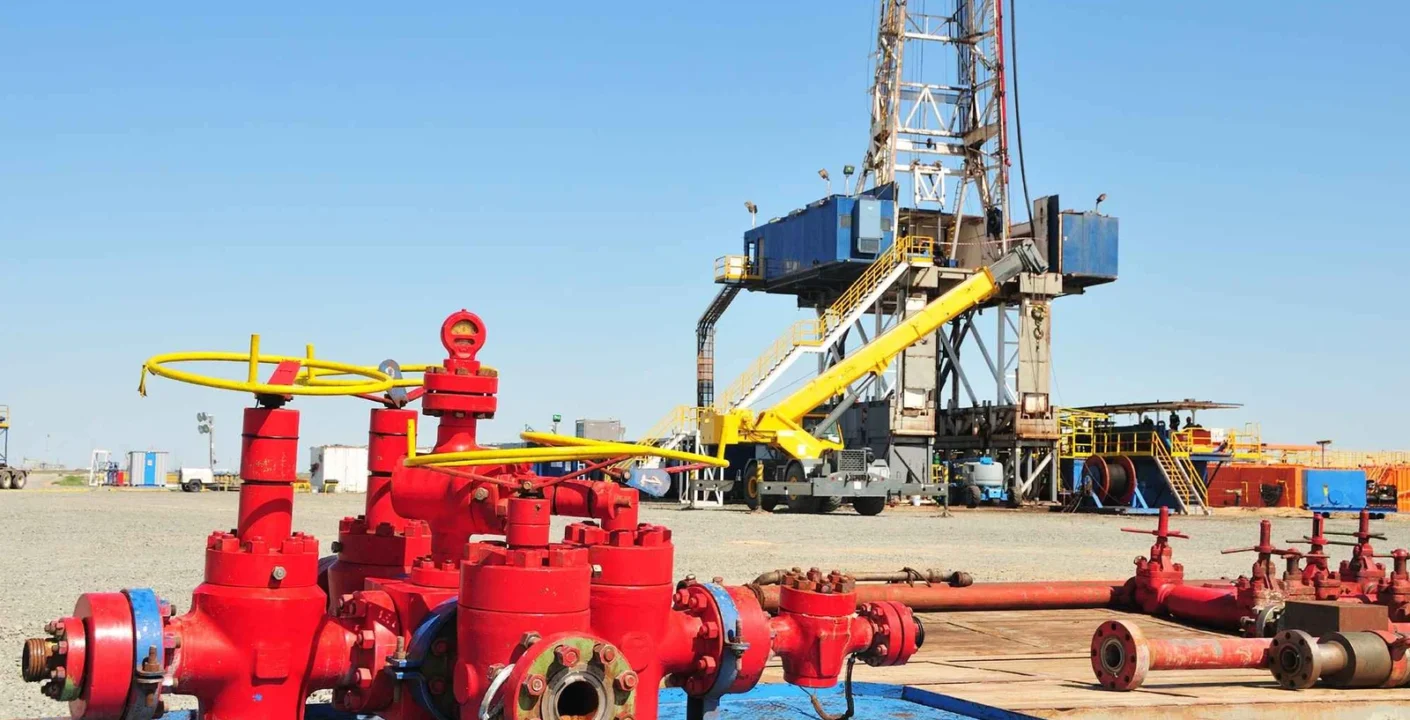
2. Wellhead and Christmas Tree Equipment
Wellhead equipment provides structural and pressure-control functions at the top of a well. It supports casing and tubing and provides interfaces for controlling the well during construction and production.
A Christmas tree is a valve and fitting assembly installed on a completed well to control and direct produced fluids. Depending on the application, it may incorporate multiple valves, chokes and pressure-control components.
When purchasing wellhead or tree equipment, buyers should pay close attention to:
- Working pressure
- Temperature rating
- Material requirements
- Connection dimensions
- Configuration
- Service conditions
- Applicable API requirements
- Testing and certification
API Specification 6A is particularly relevant to wellhead and Christmas-tree equipment, but the applicable specification should always be confirmed against the project requirements.
3. Blowout Preventers and Well-Control Equipment
A blowout preventer (BOP) is a critical well-control system used during drilling and related operations. Its purpose is to help control well pressure and prevent an uncontrolled release of formation fluids.
BOP systems can include different types of rams and annular equipment, depending on the drilling program and well configuration.
Associated choke and kill equipment supports controlled pressure management and circulation during well-control situations.
Because these systems are safety-critical, procurement should consider more than product availability. Buyers should verify pressure ratings, configuration, certification, testing records, manufacturer documentation and compatibility with the overall well-control system.
4. Casing, Tubing and Drill Pipe
Tubular products are among the most important components in well construction and production.
Casing is installed in the wellbore to provide structural support and isolate formations. Production tubing provides a flow path for produced fluids, while drill pipe is used during drilling operations.
These products are specified according to factors such as:
- Outside diameter
- Wall thickness
- Grade
- Weight
- Connection
- Length
- Service environment
- Pressure and temperature
- Corrosion and sour-service requirements
API 5CT is an important reference for casing and tubing. However, buyers should confirm the exact standard, grade and project specification rather than assuming one standard applies to every tubular requirement.
5. Valves, Pipes, Fittings and Flanges
Valves and piping components are used throughout oilfield facilities, production systems, pipelines and process installations.
Common valve types include:
- Gate valves
- Ball valves
- Check valves
- Globe valves
- Control valves
- Pressure-control valves
The correct valve depends on the service, flow conditions, pressure class, temperature, material and required function.
Pipes, fittings and flanges connect equipment and create reliable fluid-handling systems. High-pressure applications require particularly careful specification because dimensions, pressure ratings, materials and connection types must work together.
For pipeline and process applications, API, ASME and other applicable specifications may be relevant. The buyer should always identify the governing project standard before sourcing equipment.
6. Pumps, Flow Equipment and Instrumentation
Production and processing facilities require equipment to move, measure and control fluids.
Pumps may be used for water injection, transfer, circulation, chemical handling and other applications. Pump selection depends on required flow rate, pressure, fluid characteristics, temperature, power and operating conditions.
Flow meters and instrumentation provide information needed to monitor process conditions. Depending on the facility, this can include pressure, temperature, flow, level and other measurements.
Instrumentation must be compatible with the process and the surrounding environment. In hazardous areas, electrical and instrumentation requirements become particularly important.
7. Well Completion and Intervention Equipment
Drilling is only one stage of the well lifecycle. Once a well has been constructed, completion equipment enables it to enter production, while intervention equipment supports maintenance, inspection and remedial work.
Depending on the operation, equipment may include:
- Completion components
- Wireline equipment
- Coiled tubing equipment
- Pressure-control equipment
- Intervention tools
- Downhole tools
- Associated surface equipment
The exact configuration varies significantly between wells. For that reason, completion and intervention equipment should be sourced against a detailed technical specification rather than a generic product description.
8. Maintenance, MRO and Spare Parts
Oilfield operations also require a continuing supply of maintenance, repair and operations (MRO) products.
These may include hydraulic tools, pneumatic tools, power tools, lifting equipment, industrial consumables and oilfield spare parts.
For maintenance teams, availability can be as important as initial purchase price. A relatively inexpensive component that causes a prolonged shutdown may ultimately cost more than a properly specified product with reliable support.
A capable oilfield equipment supplier UAE buyers can work with should therefore be able to identify replacement requirements, source project-specific products and support recurring procurement where appropriate.
9. Safety and Supporting Equipment
Safety equipment supports personnel and facility protection across drilling, production, maintenance and industrial environments.
Depending on the facility and applicable requirements, this can include PPE, fire and gas equipment, emergency equipment, hazardous-area products and equipment associated with pressure-control safety.
Safety products should be selected according to the actual work environment and applicable regulations and standards. They should not be treated as interchangeable commodities simply because products appear similar.
Onshore vs Offshore Oilfield Equipment
The fundamental equipment categories can overlap between onshore and offshore operations, but the operating environment can change the technical and logistical requirements.
| Consideration | Onshore | Offshore |
| Environment | Land-based facilities | Marine environment |
| Logistics | Road/industrial access may be available | Marine/helicopter logistics may apply |
| Corrosion exposure | Site dependent | Saltwater and marine exposure can be significant |
| Space | Generally greater flexibility | Space and weight can be restricted |
| Maintenance | Easier physical access in many cases | Access can be more complex |
| Equipment selection | Application and site dependent | Application, environment, weight and offshore requirements |
For offshore oilfield equipment, buyers may need to consider marine exposure, lifting constraints, corrosion protection, space limitations and additional project requirements.
For onshore equipment, factors such as site conditions, transport access, temperature, dust and facility layout may be more significant.
Key API Standards for Oilfield Equipment
API standards are widely used across oil and gas equipment, but a standard should never be selected simply because it appears frequently in supplier descriptions.
The appropriate standard depends on the equipment and application.
Some important examples include:
| Equipment/application | Relevant API reference | What buyers should verify |
| Wellheads and Christmas trees | API 6A | Pressure, configuration, materials, testing |
| Casing and tubing | API 5CT | Grade, dimensions, connection, certification |
| Pipeline valves | API 6D | Valve type, size, pressure class, testing |
| Drill-through equipment | API 16A | Configuration, pressure rating, documentation |
| Choke and kill equipment | API 16C | Pressure, configuration, testing |
| Control systems | API 16D | System requirements and compatibility |
| Subsea equipment | API 17D | Subsea configuration and service requirements |
| Rotary drill-stem elements | API 7-1 | Product type, dimensions and requirements |
API’s standards ecosystem also covers drilling, well control, completion, intervention, subsea production and other upstream equipment.
The important point is that API certification or compliance should be verified against the specific product and applicable requirement. A supplier should be able to provide appropriate technical documentation rather than relying on a general statement such as “API compliant.”
What Should You Check Before Buying Oilfield Equipment?
A structured procurement process can reduce specification errors and delays.
Oilfield Equipment Buyer Checklist
- Define the application. Identify exactly where and how the equipment will be used.
- Confirm pressure and temperature. Make sure the equipment’s rating is appropriate for operating and design conditions.
- Confirm material and metallurgy. Consider corrosion, temperature and sour-service requirements where applicable.
- Check dimensions and connections. Compatibility is essential when integrating components into an existing system.
- Identify the governing standard. Confirm whether API, ASME, ASTM, ISO or an operator/project specification applies.
- Verify the manufacturer. Review manufacturer information and product documentation.
- Request certificates. Depending on the product, documentation may include certificates of conformity, material test certificates and inspection records.
- Check traceability. Product markings and documentation should support identification of the supplied equipment.
- Confirm inspection and testing. Determine whether pressure testing, FAT or other inspection requirements apply.
- Confirm delivery requirements. Check stock, lead time, transportation and project deadlines.
- Consider spare parts. For critical equipment, establish how replacements will be sourced.
- Complete technical and commercial evaluation. Price should be assessed alongside compliance, quality, delivery and lifecycle considerations.
What Documentation Should Buyers Request?
Documentation varies by product, manufacturer and project, but B2B buyers commonly need more than a commercial quotation.
Depending on the equipment, useful documentation can include:
- Technical datasheet
- Product specification
- Certificate of conformity
- Material test certificate
- Inspection and test records
- Pressure-test documentation
- Manufacturer documentation
- Product traceability information
- Calibration documentation where applicable
- Warranty information
- Packing and identification details
For critical oilfield equipment, documentation should correspond to the actual supplied product. Buyers should avoid accepting generic certificates that cannot be linked to the equipment being purchased.
How UAE Buyers Can Choose an Oilfield Equipment Supplier
Choosing an oilfield equipment supplier in UAE should begin with technical capability rather than catalogue size alone.
A suitable supplier should understand the difference between standard industrial products and equipment intended for demanding oil and gas applications.
Look for evidence of:
- Relevant product knowledge
- Reliable manufacturer or sourcing channels
- Technical specification review
- Certification and documentation support
- Traceability
- Inspection and testing capability
- UAE delivery capability
- Project and bulk-order support
- Spare-parts sourcing
- Clear quotation practices
- Experience supporting EPC and industrial procurement
For projects connected to major UAE operators and contractors, supplier registration and prequalification requirements may also be relevant.
ADNOC’s supplier ecosystem places considerable emphasis on supplier qualification, procurement requirements and local value. Buyers working on applicable projects should therefore understand the requirements of the specific operator, EPC contractor or procurement system rather than assuming that a general supplier registration is sufficient.
Local Sourcing and ICV Considerations
The UAE’s industrial strategy has increased attention on local manufacturing, supply-chain resilience and local procurement.
ADNOC’s In-Country Value framework is particularly relevant to companies participating in its supply chain. Depending on the procurement route, local sourcing and supplier qualification can influence commercial evaluation.
This does not mean that every oilfield equipment purchase must be locally manufactured. Instead, procurement teams should determine whether local-content, ICV or approved-supplier requirements apply to their particular project.
For UAE buyers, working with a supplier that understands the local procurement environment can simplify sourcing and documentation.
Why Work With a Specialized Equipment Trading Company?
An equipment trading company can add value when the required product is highly specialized, has a long lead time or needs to be sourced from multiple manufacturers.
For example, an EPC contractor may have a project requiring valves, fittings, pressure-control equipment, instrumentation and spare parts from different approved manufacturers. A specialized trader can coordinate sourcing around the technical specifications and delivery schedule.
QSM LLC supports equipment trading requirements for industrial and energy-sector buyers, including oilfield equipment sourcing. For a project-specific requirement, buyers should provide the equipment description, specification, quantity, applicable standard and required delivery date when requesting a quotation.
Read our guide oilfield equipment supplier UAE to explore the wider equipment-sourcing considerations for UAE buyers.
When Should You Source Oilfield Equipment?
Early procurement is particularly important for equipment with long manufacturing or certification lead times.
Planning ahead is useful for:
- New drilling projects
- EPC project procurement
- Well construction
- Major maintenance campaigns
- Shutdowns and turnarounds
- Emergency replacement planning
- Bulk equipment purchases
- Long-lead equipment
- Planned spare-parts programs
For urgent requirements, provide as much technical information as possible with the RFQ. A clear specification helps suppliers identify suitable products faster and reduces the risk of repeated clarification.
Final Thoughts
The essential oilfield equipment used in the UAE spans far more than drilling machinery. Reliable energy operations depend on an interconnected system of drilling equipment, drill pipes, wellheads, Christmas trees, BOPs, casing, tubing, valves, piping, pumps, instrumentation, completion and intervention equipment, maintenance products and safety systems.
For procurement teams, the most important decision is not simply where to buy oilfield equipment in UAE, but whether the supplied equipment is technically suitable, properly documented, traceable and available when the project requires it.
QSM LLC can support UAE B2B buyers looking for oilfield equipment sourcing and equipment-trading solutions. The best starting point is a detailed RFQ containing the required specifications, quantities, standards, documentation requirements and delivery expectations.
FAQs
What is oilfield equipment?
Oilfield equipment includes the machinery, tools, tubulars, pressure-control systems, valves, wellhead equipment, pumps, instrumentation and supporting products used to drill, complete, produce and maintain oil and gas wells and facilities.
What equipment is essential for oil drilling?
Common drilling equipment includes drilling rigs, drill pipes, drill collars, drill bits, rotary equipment, drill-stem components and well-control equipment such as BOP systems. The exact package depends on the well design and drilling program.
What equipment is used in oil and gas production?
Production operations can require wellheads, Christmas trees, valves, pumps, tubing, piping, fittings, instrumentation, flow meters, pressure-control equipment and various maintenance and safety products.
What oilfield equipment is commonly supplied in the UAE?
Common categories include drilling equipment, drill pipes, wellhead equipment, BOPs, valves, pipes, fittings, flanges, pumps, instrumentation, completion equipment, intervention tools and oilfield spare parts.
What API standards apply to oilfield equipment?
The applicable API standard depends on the equipment. Examples include API 6A for wellhead and Christmas-tree equipment, API 5CT for casing and tubing, API 6D for pipeline valves and API 16C for choke and kill equipment.
What certificates should an oilfield equipment supplier provide?
Depending on the product and project, documentation may include certificates of conformity, material test certificates, inspection records, pressure-test records, datasheets, manufacturer documentation and traceability information.
What should I check before buying oilfield equipment?
Check the application, pressure, temperature, material, dimensions, connections, applicable standards, manufacturer, certification, testing, traceability, delivery schedule, warranty and spare-parts availability.
What is the difference between drilling and production equipment?
Drilling equipment is primarily used to construct the wellbore, while production equipment supports the controlled extraction and handling of oil and gas after the well has been completed.
What is the difference between onshore and offshore oilfield equipment?
The core equipment categories can be similar, but offshore applications may impose additional requirements related to marine corrosion, space, weight, lifting, logistics and environmental exposure.
How do UAE oilfield equipment suppliers support EPC contractors?
Suppliers can support EPC procurement by sourcing specified products, coordinating manufacturers, providing technical documentation, managing quotations, supporting bulk orders and arranging delivery according to project requirements.
How can I request an oilfield equipment quotation in the UAE?
Provide the supplier with the product description, quantity, technical specification, dimensions, pressure and temperature requirements, applicable standard, required documentation and delivery location and deadline. This allows the supplier to prepare a more accurate quotation.
Is the cheapest oilfield equipment always the best choice?
No. The lowest purchase price may not represent the lowest overall cost. Technical compliance, reliability, documentation, lead time, maintenance requirements, spare-parts availability and operational risk should also be considered.