
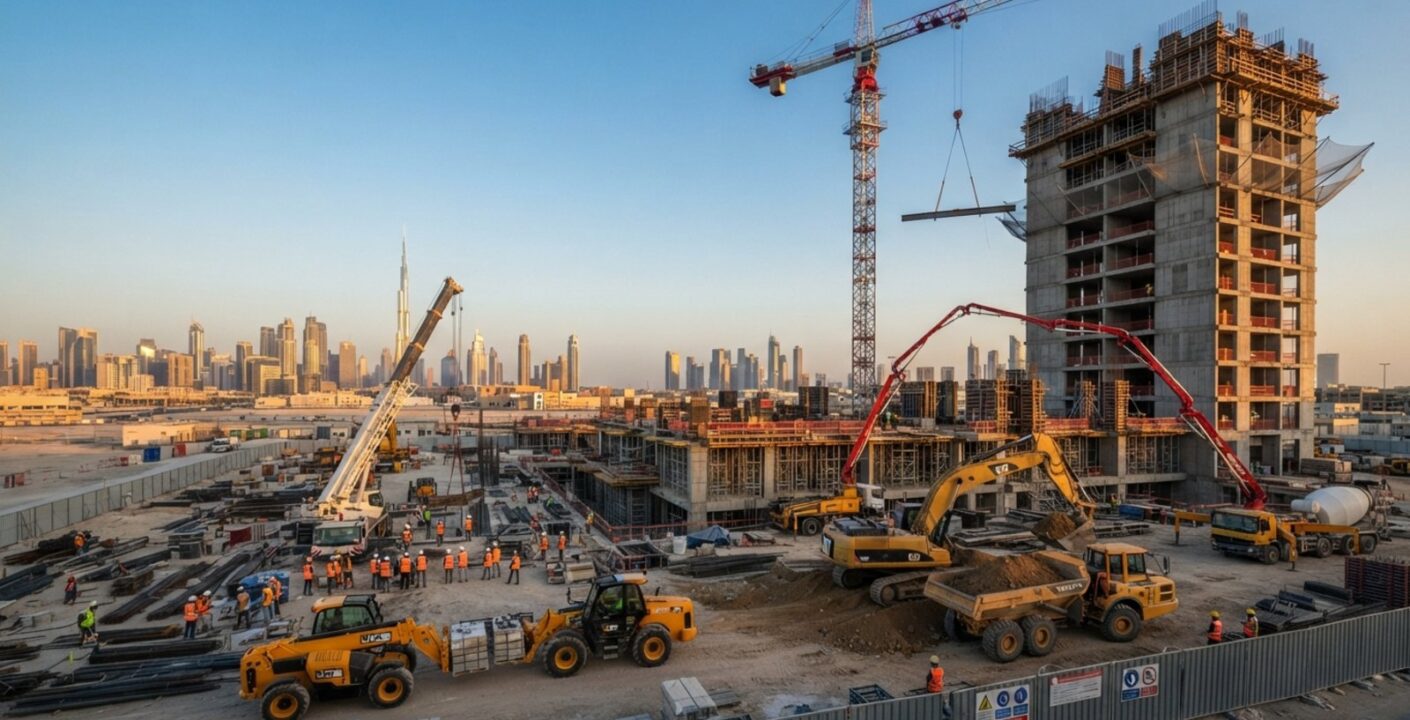
Large construction projects require a carefully selected combination of heavy machinery, lifting equipment, transportation vehicles, concrete machinery, and site-support systems. The equipment needed depends on the project’s size, construction method, ground conditions, workload, and completion schedule. From excavating foundations to lifting structural components and preparing roads, each machine performs a specific role in keeping construction operations productive and organised.
For contractors, project managers, civil engineers, and procurement teams, understanding these requirements is essential before mobilising a construction site. Choosing suitable machinery helps manage material movement, reduce unnecessary delays, improve site productivity, and maintain safe working conditions.
Essential Types of Heavy Construction Equipment
A large construction project rarely depends on one type of machinery. Contractors generally require equipment across several categories to support different construction activities.
1. Earthmoving Equipment
Earthmoving machinery is essential during site preparation, excavation, grading, and foundation work. These machines remove soil, move aggregates, level surfaces, and prepare construction areas.
Common earthmoving equipment includes:
- Hydraulic excavators: Used for digging foundations, trenches, drainage channels, and large excavations. Crawler excavators are particularly useful on challenging ground conditions.
- Bulldozers: Push soil, clear construction areas, spread materials, and perform rough grading.
- Wheel loaders: Load sand, gravel, soil, and aggregates into trucks or move materials around the site.
- Backhoe loaders: Combine digging and loading functions, making them useful for smaller excavation and utility activities.
- Motor graders: Create level surfaces and prepare roadbeds and construction platforms.
Selecting the correct machine depends on excavation depth, bucket capacity, operating weight, engine horsepower, and ground pressure.
2. Lifting and Material-Handling Equipment
Large projects involve moving heavy materials, structural components, machinery, and construction supplies. Lifting and material-handling equipment makes these operations possible.
Important machinery includes:
- Tower cranes: Commonly used in high-rise buildings to lift steel, concrete materials, and other loads to elevated levels.
- Mobile cranes: Provide flexible lifting capabilities for industrial facilities, structural installations, and general construction.
- Crawler cranes: Suitable for heavy lifting operations where their tracked configuration and lifting capacity meet site requirements.
- Forklifts: Move palletised materials, equipment, and supplies across construction sites.
- Telehandlers: Lift and position materials at different heights and working distances.
- Construction hoists: Transport workers and materials between different levels of a building.
When selecting a crane, consider rated load capacity, maximum lifting height, working radius, load charts, ground conditions, and the Safe Working Load (SWL) of associated lifting accessories.
3. Concrete Construction Equipment
Concrete is a major component of buildings, foundations, bridges, industrial facilities, and infrastructure projects. Large-scale concrete work requires equipment that can prepare, transport, place, and compact concrete efficiently.
Common concrete machinery includes:
- Concrete batching plants: Combine cement, aggregates, water, and other approved materials in controlled proportions.
- Transit mixers: Transport ready-mixed concrete from batching facilities to construction sites.
- Concrete pumps: Deliver concrete to foundations, slabs, columns, and elevated structures.
- Concrete vibrators: Remove trapped air and help compact freshly placed concrete.
The required equipment depends on concrete volume, pouring location, project specifications, and the distance between mixing and placement areas.
4. Foundation and Drilling Equipment
Foundation work provides structural support for buildings, bridges, industrial facilities, and other major developments. Depending on soil conditions and engineering requirements, contractors may need specialised machinery.
Examples include:
- Piling rigs: Install piles that transfer structural loads into suitable soil or rock layers.
- Drilling rigs: Create boreholes for foundation, geotechnical, and other drilling operations.
- Pile drivers: Install piles using an appropriate driving method.
- Hydraulic breakers: Break rock, concrete, and other hard materials during excavation.
- Trenchers: Dig trenches for underground utilities, pipelines, and drainage systems.
Foundation equipment must be selected according to geotechnical reports, pile specifications, excavation requirements, and site access.
5. Transportation and Hauling Equipment
Moving materials between different work areas is another important part of construction operations. Large projects need reliable transportation equipment to handle excavated soil, aggregates, construction materials, and heavy machinery.
Common options include dump trucks, tipper trucks, articulated haulers, and flatbed trailers.
Dump trucks and articulated haulers transport bulk materials, while flatbed trailers can move machinery and large construction components. The selection should account for payload capacity, access roads, ground conditions, loading requirements, and transport distances.
6. Road Construction and Compaction Equipment
Roads, highways, access routes, and external infrastructure require specialised machinery for preparing and finishing surfaces.
Important equipment includes:
- Asphalt pavers: Distribute asphalt mixtures across prepared road surfaces.
- Road rollers: Compact asphalt and other road materials.
- Vibratory rollers: Compact suitable soil, aggregates, and asphalt layers.
- Soil compactors: Improve soil density for foundations, embankments, and roadbeds.
- Motor graders: Shape and level surfaces before subsequent construction activities.
Proper compaction is important because inadequate preparation can affect pavement performance and the stability of constructed surfaces.
7. Site-Support and Access Equipment
Construction projects also depend on equipment that supports everyday site operations. Although these machines may not directly build the main structure, they help maintain working conditions and operational continuity.
Examples include:
- Diesel generators: Provide temporary electrical power where permanent supply is unavailable or insufficient.
- Air compressors: Supply compressed air for compatible tools and equipment.
- Dewatering pumps: Remove unwanted water from excavations and construction areas.
- Light towers: Improve visibility during night work and in poorly illuminated areas.
- Scissor lifts and boom lifts: Provide elevated access for installation, inspection, and maintenance activities.
- Scaffolding: Creates temporary working platforms for suitable construction tasks.
The required equipment should be determined by site layout, utility availability, working heights, and project-specific safety arrangements.
What Equipment Is Needed for Different Construction Projects?
Not every large project requires the same machinery. Equipment requirements change according to the structure, construction method, and site conditions.
| Project type | Commonly required equipment |
| High-rise buildings | Tower cranes, construction hoists, excavators, concrete pumps, generators, and access equipment |
| Industrial facilities | Mobile cranes, forklifts, telehandlers, piling rigs, concrete equipment, and material-handling machinery |
| Roads and highways | Motor graders, bulldozers, asphalt pavers, rollers, compactors, and dump trucks |
| Bridges and infrastructure | Crawler cranes, piling rigs, excavators, concrete pumps, and heavy transport vehicles |
| Large residential developments | Excavators, wheel loaders, concrete mixers, mobile cranes, dump trucks, and generators |
For example, a high-rise development may need tower cranes and construction hoists throughout structural work. A highway project, however, will depend more heavily on graders, asphalt pavers, soil compactors, and road rollers.
How Equipment Supports Different Construction Phases
Planning machinery around construction phases helps contractors avoid unnecessary equipment mobilisation and scheduling problems.
- Site preparation: Bulldozers, excavators, and wheel loaders clear and prepare the land.
- Excavation: Hydraulic excavators, dump trucks, and rock breakers handle soil and material removal.
- Foundation construction: Piling rigs, drilling equipment, concrete pumps, and vibrators support foundation installation.
- Structural work: Tower cranes, mobile cranes, hoists, and concrete machinery support building construction.
- Material handling: Forklifts, telehandlers, and trailers move supplies between work areas.
- Roadwork and external infrastructure: Graders, pavers, and rollers prepare and finish surfaces.
- Finishing and site operations: Boom lifts, scissor lifts, generators, compressors, and light towers support remaining activities.
Some equipment is needed throughout the project, while specialised machines may only be required for particular stages.
How to Choose the Right Construction Equipment
Selecting heavy construction equipment requires more than comparing machine sizes or purchase prices. Contractors should evaluate the actual demands of the project before making procurement decisions.
Consider these factors:
- Project requirements: Identify the tasks, workload, and construction methods the equipment must support.
- Operating capacity: Check bucket capacity, rated load capacity, lifting height, and other relevant performance specifications.
- Site conditions: Consider soil type, ground pressure, access restrictions, working space, and terrain.
- Power and efficiency: Compare engine horsepower, fuel consumption, and expected operating hours.
- Equipment compatibility: Confirm that machinery can work safely and effectively alongside other site equipment.
- Maintenance requirements: Assess preventive maintenance schedules, spare-parts availability, and service arrangements.
- Transport and mobilisation: Check delivery access, transport dimensions, loading arrangements, and project scheduling.
For more information about machinery categories and their applications, read our guide to heavy construction equipment.
Should Contractors Buy or Rent Heavy Construction Equipment?
The decision to purchase or rent equipment depends on project duration, utilisation, available capital, and maintenance responsibilities.
| Consideration | Buying equipment | Renting equipment |
| Project duration | Often suitable for repeated or long-term use | Often suitable for short-term requirements |
| Initial investment | Requires greater upfront capital | Usually involves a lower initial commitment |
| Maintenance | Ownership responsibilities apply | Responsibilities depend on the rental agreement |
| Equipment availability | Equipment may be available for scheduled projects | Availability depends on the rental market |
| Long-term value | May retain resale or operational value | No ownership asset is created |
Buying can make sense when a contractor regularly uses the same machinery across multiple projects. Renting may be more practical for specialised equipment needed only occasionally.
A total cost of ownership assessment should consider purchase price, fuel, maintenance, transportation, downtime, insurance, and expected utilisation.
Important Equipment Procurement Considerations in the UAE and GCC
Contractors sourcing construction machinery in the UAE and wider GCC should consider local site conditions, transport arrangements, equipment documentation, and applicable safety requirements.
In the UAE, lifting equipment requirements can vary by emirate and project authority. Dubai Development Authority Circular 614, Dubai Municipality guidance, and Abu Dhabi’s ADOSH-SF Code of Practice 34.0 provide relevant examples of requirements relating to lifting equipment inspection, certification, competent personnel, and documentation.
Buyers should verify the current requirements applicable to their specific project rather than assuming one regulation applies throughout the GCC.
When evaluating construction equipment suppliers in UAE, procurement teams should also check:
- Equipment specifications and manufacturer documentation
- Inspection and certification records where applicable
- Rated capacities and load charts
- Spare-parts availability
- Delivery and mobilisation arrangements
- Warranty and maintenance terms
- Supplier experience with the required equipment category
QSM LLC is an equipment trading and supply company serving business procurement needs. Contractors and project teams can contact QSM LLC to discuss their equipment sourcing requirements.
Final Thoughts
Large construction projects require a coordinated range of earthmoving, lifting, concrete, foundation, transportation, road-building, and site-support equipment. The right machinery depends on the construction phase, project specifications, ground conditions, workload, and operational schedule.
For contractors and procurement teams in the UAE and GCC, careful equipment selection is essential. Comparing technical specifications, operating capacity, maintenance requirements, supplier documentation, and total cost of ownership helps businesses make informed purchasing decisions and prepare their projects more effectively.
FAQs
1. What equipment is most important for large construction projects?
Excavators, bulldozers, cranes, wheel loaders, dump trucks, concrete pumps, and compactors are among the most commonly required machines. The exact equipment list depends on the project type and construction activities.
2. What machinery is required for excavation and earthmoving?
Excavators, bulldozers, backhoe loaders, wheel loaders, motor graders, dump trucks, and hydraulic breakers are commonly used for excavation and earthmoving.
3. What equipment is needed for high-rise building construction?
High-rise projects commonly require tower cranes, construction hoists, mobile cranes, concrete pumps, transit mixers, generators, and elevated access equipment.
4. Which equipment is used for concrete construction?
Concrete batching plants, transit mixers, concrete pumps, and concrete vibrators are commonly used to prepare, transport, place, and compact concrete.
5. Should construction companies buy or rent heavy equipment?
Buying is often suitable for machinery used regularly across multiple projects. Renting can be more practical for specialised equipment or temporary requirements. Contractors should compare utilisation, capital costs, maintenance, and rental availability.
6. What should buyers check before purchasing construction machinery?
Buyers should check operating capacity, rated load capacity, machine condition, technical specifications, fuel efficiency, inspection records, maintenance requirements, spare-parts availability, and supplier documentation.
7. Is construction equipment procurement different across the GCC?
The main equipment categories are broadly similar, but safety requirements, inspection procedures, transport regulations, and project-authority requirements can differ between the UAE, Saudi Arabia, Qatar, Oman, Kuwait, and Bahrain.
8. Where can businesses source construction equipment in the UAE?
Businesses can approach equipment trading companies and suppliers in the UAE, compare available machinery against project specifications, and verify documentation and procurement terms. QSM LLC can be contacted at +971 50 370 1273 to discuss equipment sourcing requirements.